

Catheter Simulation Using Virtual Reality


Catheter simulation using virtual reality
Simulations can be performed by bringing into the virtual space polygon files created from the pre-treatment CT scan, as well as polygon files of the catheters and treatment tools to be used, and freely manipulating and observing them.
PCI
Guiding Catheter Simulation
It is possible to perform all kinds of simulations related to guiding catheters, such as how to deal with anomalous coronary artery origins, coaxiality with the coronary artery, and confirmation of the size of the guiding catheter.
Higami H, et al. A case report of virtual reality-guided percutaneous coronary intervention for anomalous origin of right artery coronary chronic total occlusion. Eur Heart J Case Rep. 2023 Oct 11;7(10):ytad507.

PCI after TAVI
Coronary Artery Access Simulation
After TAVI valve placement, the alignment of the TAVI valve to the commissure and the height of the Neo-Sinus to the coronary artery can be evaluated, allowing simulation of the optimal access route and catheter shape for coronary artery access.
LAAC (percutaneous left atrial appendage closure)
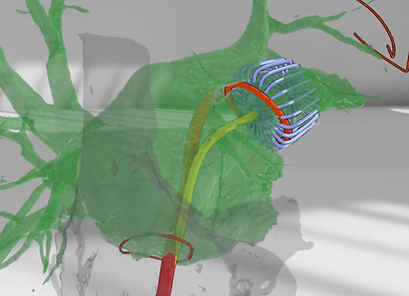
Simulation of left atrial appendage closure device placement
It is possible to simulate the size of the device used for left atrial appendage closure, the type of sheath, and the atrial septal puncture position, and to estimate the degree of difficulty and the need for changes in sheath shape.
Shimura T, et al.. Appropriate assessment using virtual reality simulation for a novel reshaped curve sheath during percutaneous left atrial appendage closure: a follow-up case report. Eur Heart J Case Rep. 2023 Oct 9;7(11):ytad503.
Branch embolism during EVAR (aortic stent graft placement)
Lumbar, inferior mesenteric and sacral artery embolization simulation
When performing branch embolization before EVAR, the catheter approach (left or right) can be selected, the catheter shape can be selected, and an image can be visualized when the catheter is engaged.
